Articles
AI security
- How to protect AI agents: isolation, memory, guardrails
- Can prompt injection come through audio? We tested 11 transcribers
- AI Firewall for MCP: check what your agent reads, on any model
- Zabio AI Firewall: prompt injection protection on every call, free
AI costs
- Which OpenAI models shut down soon, and what replaces them?
- Sub-agents on Zabio: Opus decides, a cheap model reads
- Why I built Zabio
Agents and coding tools
On this page
- Overview
- Which OpenAI models shut down, and when?
- How do you find where you still call them?
- How do you test the replacement before you switch?
- Which replacement should you pick when OpenAI names two?
- What if you call these models through Zabio?
- How we checked
- Frequently asked questions
- Sources and references
- Related articles
Which OpenAI models shut down soon, and what replaces them?
gpt-5, gpt-5-mini, gpt-5-nano and o3 shut down on Dec 11, 2026; GPT-4o and GPT-4.1 on Jan 14. OpenAI's replacements and how to switch safely.
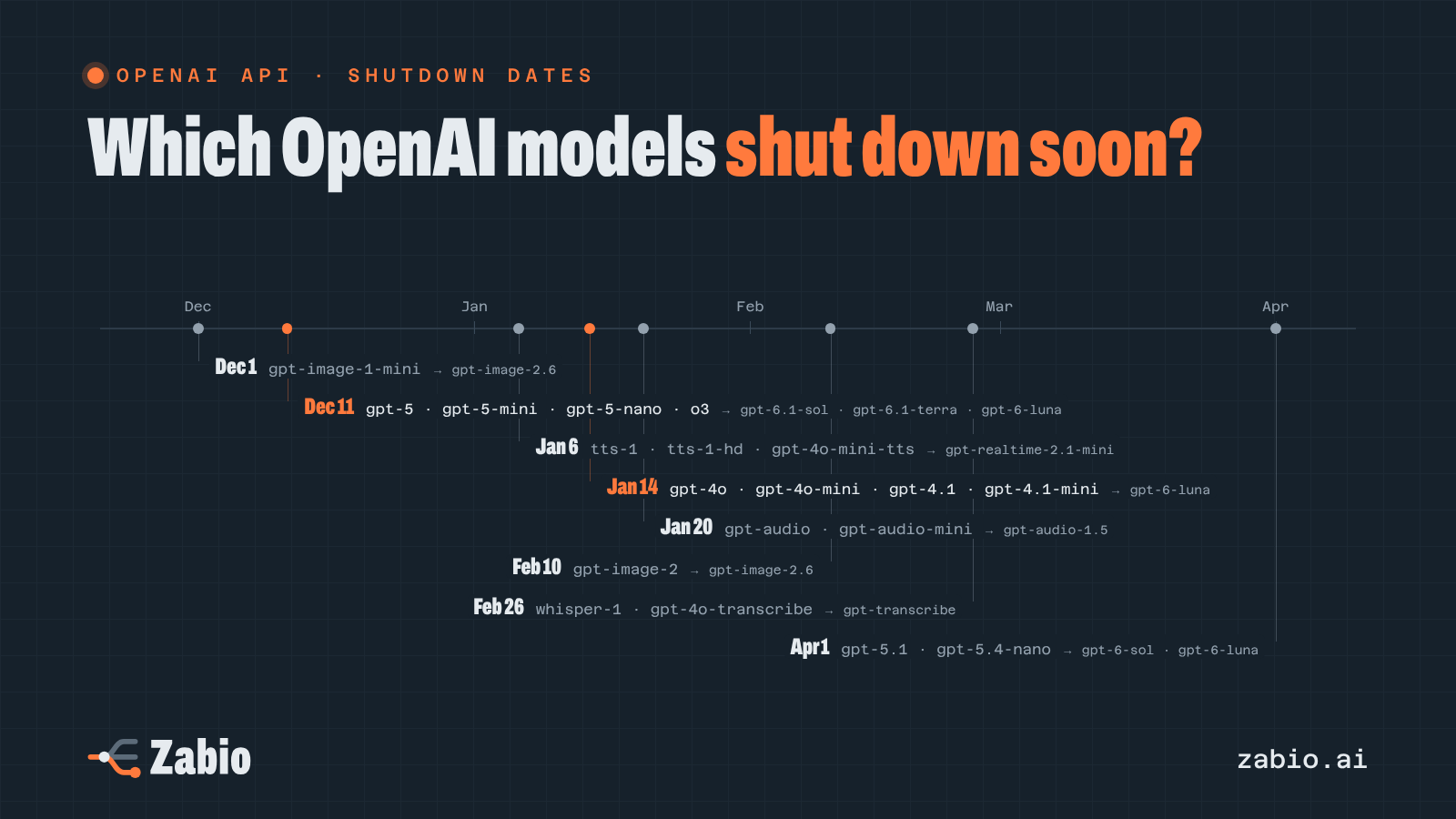
OpenAI shuts down a large part of its older API lineup over the next five months. gpt-image-1-mini goes first, on December 1, 2026. gpt-5, gpt-5-mini, gpt-5-nano and o3 follow on December 11, the GPT-4o and GPT-4.1 models on January 14, 2027, and the older transcription models on February 26. For each one, OpenAI names a replacement: mostly gpt-6.1-sol, gpt-6.1-terra and gpt-6-luna.
Which OpenAI models shut down, and when?
Everything below comes from OpenAI’s deprecations page, which lists a shutdown date and a recommended replacement for each model. Dated snapshots of a model (gpt-5-2025-08-07, for example) shut down with it.
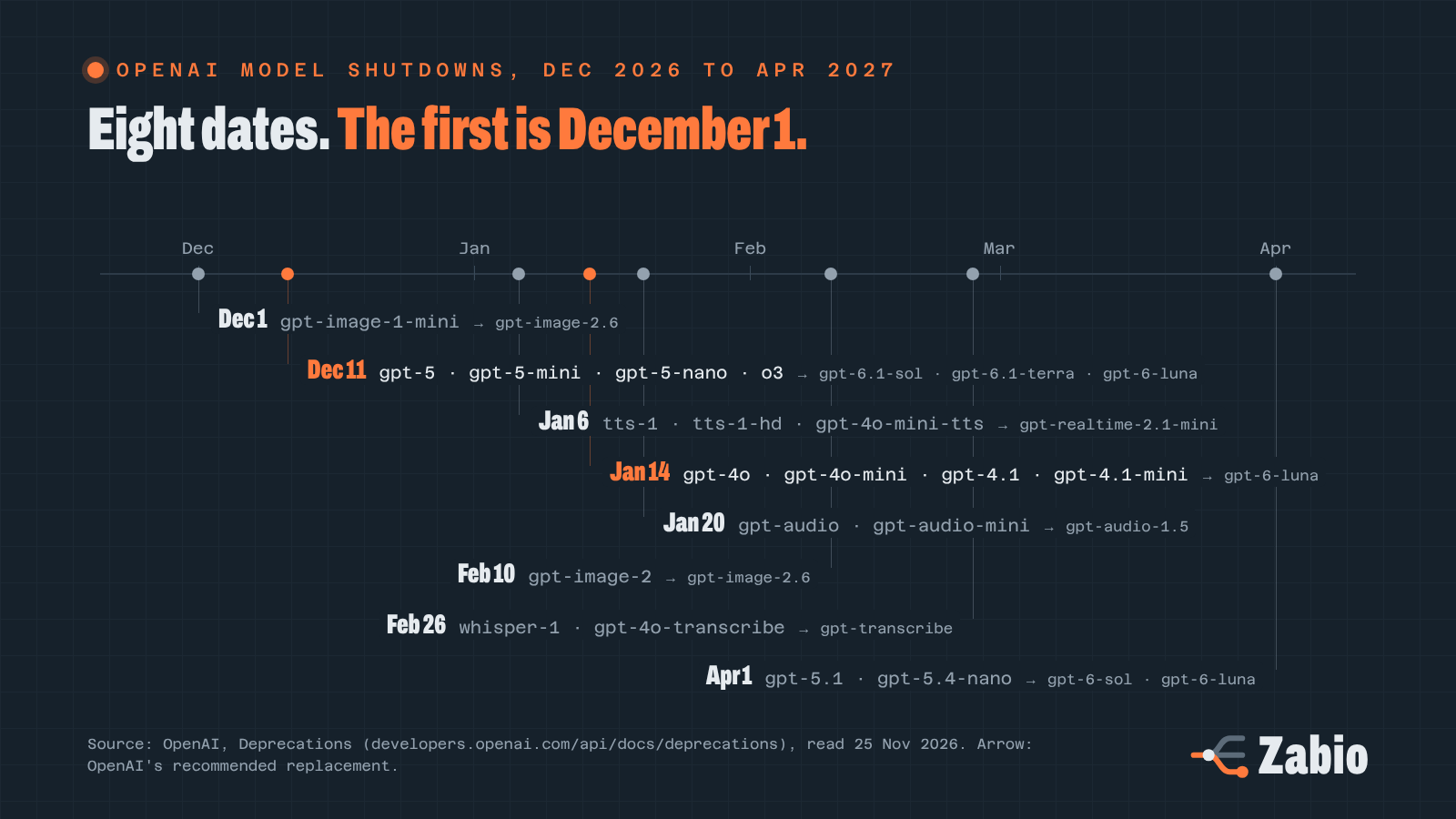
| Shutdown date | Model | OpenAI’s recommended replacement |
|---|---|---|
| Dec 1, 2026 | gpt-image-1-mini, gpt-image-1.5, chatgpt-image-latest |
gpt-image-2.6-sunburst or gpt-image-2.6-flare |
| Dec 11, 2026 | gpt-5 |
gpt-6.1-sol |
| Dec 11, 2026 | gpt-5-mini |
gpt-6.1-terra |
| Dec 11, 2026 | gpt-5-nano |
gpt-6-luna |
| Dec 11, 2026 | o3 |
gpt-6.1-sol |
| Dec 11, 2026 | gpt-5-pro, o3-pro |
gpt-6.1-sol with reasoning.mode: pro, in the Responses API |
| Jan 6, 2027 | tts-1, tts-1-hd, gpt-4o-mini-tts |
gpt-realtime-2.1-mini |
| Jan 14, 2027 | gpt-4o, gpt-4o-mini, gpt-4.1, gpt-4.1-mini |
gpt-6-luna |
| Jan 20, 2027 | gpt-audio, gpt-audio-mini, gpt-4o-audio, gpt-4o-mini-audio |
gpt-audio-1.5 |
| Jan 20, 2027 | gpt-realtime, gpt-4o-realtime, gpt-realtime-mini, gpt-4o-mini-realtime |
gpt-realtime-2.1 (for the mini models, gpt-realtime-2.1-mini) |
| Feb 1, 2027 | gpt-5.5-cyber-preview |
the most capable cyber model available to you (OpenAI’s words) |
| Feb 10, 2027 | gpt-image-2 |
gpt-image-2.6-sunburst or gpt-image-2.6-flare |
| Feb 26, 2027 | whisper-1, gpt-4o-transcribe, gpt-4o-mini-transcribe, gpt-4o-transcribe-diarize |
gpt-live-transcribe or gpt-transcribe |
| Apr 1, 2027 | gpt-5.1, gpt-5.3-codex |
gpt-6-sol |
| Apr 1, 2027 | gpt-5.4-nano |
gpt-6-luna |
Some platform features close too: /v1/prompts and reusable prompt objects, the Evals dashboard and API, and Agent Builder on November 30, 2026, and /v1/audio/translations on February 26, 2027.
How do you find where you still call them?
The model name is usually in more places than the code that calls the API. Before you plan the switch, find all of them:
- Search the code and the configuration for each model id, its dated snapshots and its aliases: environment variables, YAML and JSON files, prompt templates, infrastructure code.
- Read your usage by model for the last 30 days. Low-traffic paths (a monthly report, an admin tool, a fallback) are the ones a code search misses.
- Check what your tools choose for you. SDK defaults, framework defaults and agent configs often name a model you never typed.
- List the side features: a fine-tuned model built on a retiring base, a batch job that runs once a month, a prompt object stored in the platform.
How do you test the replacement before you switch?
Swap the name on a copy of real traffic first, and compare. A replacement is a different model, even when the API call looks the same:
- Answers: run a sample of real requests through both models and check the results the way you would check your own code: exact values where they exist, a schema check for structured output, your own review for the rest.
- Length and reasoning: a newer model can write longer answers or spend more tokens reasoning. Check that your
max_tokensstill leaves room for the answer, and compare the cost per request, not the price per token. - Formats and tools: structured output, function calling and stop sequences are where small differences break parsers.
- Latency: time the slow cases, not the median.
- What the model keeps: our own data shows how much replacements can differ. In our test of transcription models with spoken prompt injections, OpenAI’s
gpt-transcribe, the replacement forgpt-4o-transcribe, kept the injected sentence in 30 of 36 recordings.gpt-4o-transcribekept it in 11, andwhisper-1in 33 (the full results). If your app relies on what a model keeps or drops, measure it.
Switch once the replacement passes your checks, well before the date, and keep a rollback path until the old model is gone.
Which replacement should you pick when OpenAI names two?
Pick by the job, not by the name. For images, OpenAI names gpt-image-2.6-sunburst or gpt-image-2.6-flare; for transcription, gpt-live-transcribe (live audio) or gpt-transcribe (files). Run your own prompts through both and compare quality, speed and cost on your work. OpenAI’s models page describes gpt-6-luna as its most efficient model for focused, high-volume tasks and gpt-6.1-terra as a fast model for visual reasoning and computer use, which is a starting point, not a test.
What if you call these models through Zabio?
Zabio follows the vendors’ dates and tells you before a model goes. A retiring model carries retires_at in GET /v1/models, and successor when the vendor names one. Every request that names it carries an x-zabio-retires-at header, so you can log or alert on it. auto stops choosing a retiring model 10 days before the date. After the date, a request that names it gets a 410 model_retired that names the successor, before any work is done. Of OpenAI’s named replacements, gpt-6.1-sol, gpt-6.1-terra, gpt-6-luna, gpt-6-sol, gpt-audio-1.5 and gpt-transcribe are on Zabio today, under the same key as models from Anthropic, Google and others. See Models and, for checking a replacement’s answers automatically, the final review.
How we checked
- Dates and replacements: read from OpenAI’s deprecations page on 27 November 2026, and matched against the retirement dates in Zabio’s catalog for every OpenAI model Zabio serves. OpenAI can change them; check its page before you plan.
- Transcription numbers: from Zabio’s audio prompt injection test of 22 and 23 November 2026 (36 recordings, 11 transcription models), described in that article.
- What we did not check: how each replacement performs on your work. That is the test above.
Frequently asked questions
When does gpt-5 shut down?
OpenAI shuts down gpt-5, gpt-5-mini, gpt-5-nano and their dated snapshots on December 11, 2026. OpenAI names gpt-6.1-sol as the replacement for gpt-5, gpt-6.1-terra for gpt-5-mini and gpt-6-luna for gpt-5-nano.
What replaces GPT-4o and GPT-4.1 in the OpenAI API?
OpenAI names gpt-6-luna as the replacement for GPT-4o, GPT-4o mini, GPT-4.1 and GPT-4.1 mini, which shut down on January 14, 2027.
What happens if my app still calls a model after its shutdown date?
The model is no longer served, so the request fails. Find every place that names the model, test the replacement on real requests, and switch before the date.
Can I swap the model name and be done?
Often, but test first. A newer model can write longer answers, spend more tokens reasoning, follow formats differently or keep different content. Run a sample of real requests through both and compare the results with checks you trust.
What replaces o3-pro and gpt-5-pro?
OpenAI names gpt-6.1-sol with reasoning.mode set to pro, in the Responses API, as the replacement for both, which shut down on December 11, 2026.
Sources and references
- OpenAI, Deprecations (API docs) developers.openai.com
- OpenAI, Models (API docs) developers.openai.com
- OpenAI, File transcription guide (API docs) developers.openai.com
- OpenAI, Image generation guide (API docs) developers.openai.com
- Zabio, Can prompt injection come through audio? We tested 11 transcribers zabio.ai
- Zabio, Models: retirement dates and successors (docs) zabio.ai
Build your prototype free
Change two lines in your code, send model auto, and see what every call cost and what you saved.