Articles
AI security
- How to protect AI agents: isolation, memory, guardrails
- Can prompt injection come through audio? We tested 11 transcribers
- AI Firewall for MCP: check what your agent reads, on any model
- Zabio AI Firewall: prompt injection protection on every call, free
AI costs
- Which OpenAI models shut down soon, and what replaces them?
- Sub-agents on Zabio: Opus decides, a cheap model reads
- Why I built Zabio
Agents and coding tools
On this page
- Overview
- Can one LLM check another LLM’s work?
- What happened on short agent tasks?
- Does a final review work on long agent sessions?
- Why does a review at the end beat an advisor at the start?
- How many reviews does a long task need?
- What does the review cost against the strong model?
- When is the reviewer wrong?
- How to add a second-model review
- How we measured
- Frequently asked questions
- Sources and references
- Related articles
Does a second-model review catch LLM mistakes? We measured
On 20 long agent sessions, a Claude Opus 5.5 review took gpt-6-luna from 10 to 18 right, at 38% of what Opus alone cost. Our data and method.
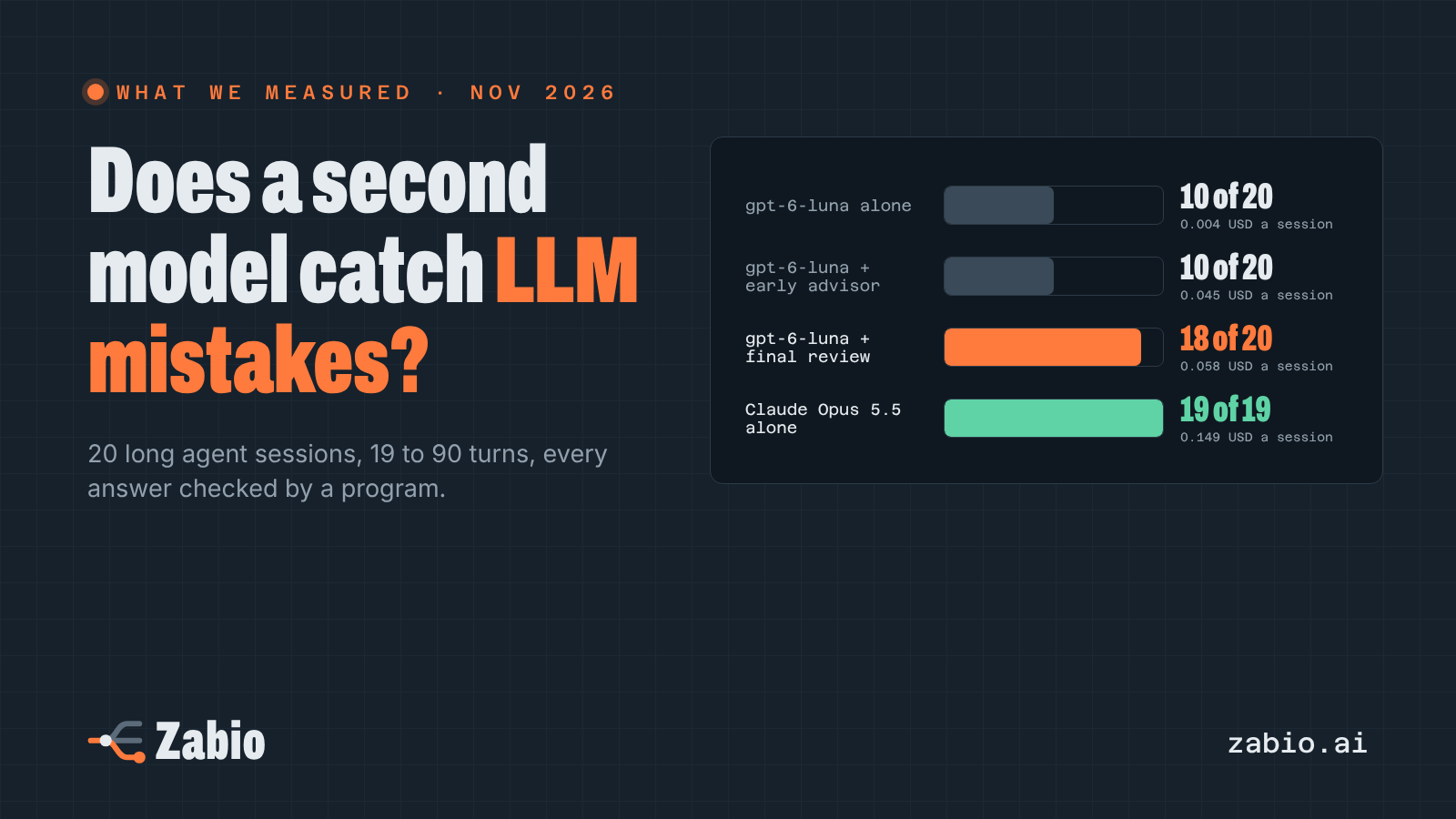
Yes, a second model can catch most of an LLM’s mistakes, if it reads the whole conversation after the answer is written. In Zabio’s test of November 2026 on 20 long agent sessions, OpenAI’s gpt-6-luna was right on 10 alone and on 18 with a final review by Anthropic’s Claude Opus 5.5, at 38 percent of what Opus cost doing the work itself. An advisor consulted early in the same sessions lifted nothing.
Can one LLM check another LLM’s work?
It can, and the condition is the data. A model that reviews its own answer with no new information often makes it worse (Huang et al.). Strong models used as judges agree with human raters about as often as humans agree with each other (Zheng et al.), and trained critics catch bugs that people miss (McAleese et al.). What we wanted to know is narrower: does a second model, from another vendor, reading a cheap model’s finished work, turn wrong answers into right ones without breaking the right ones?
We tested it first on 12 short agent tasks, then on 20 long sessions where cheap models make their mistakes late.
What happened on short agent tasks?
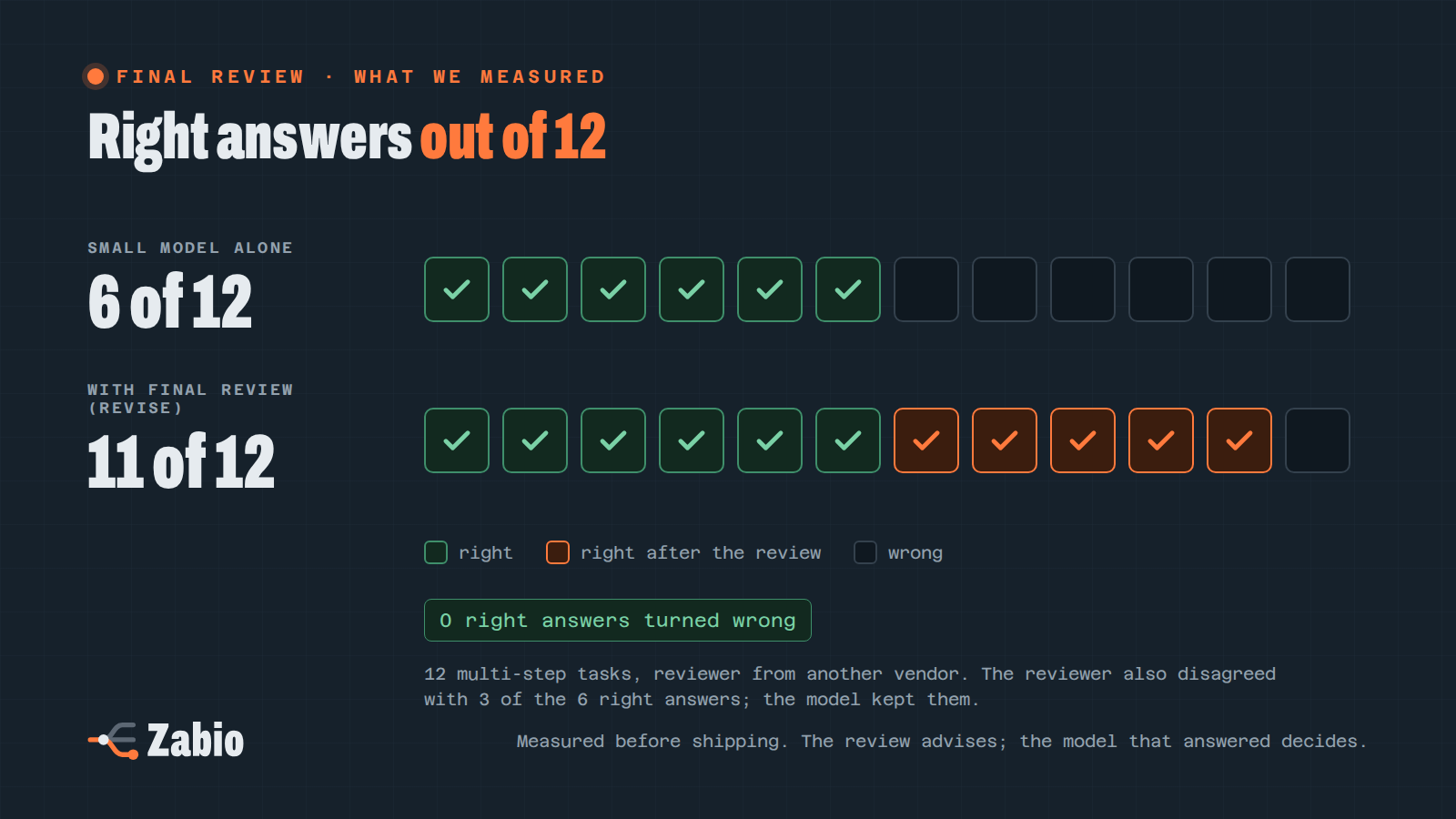
On 12 multi-step tasks (refund checks, incident triage, approvals and session logs), Anthropic’s claude-haiku-5-5 answered and OpenAI’s gpt-6.1-sol reviewed. Haiku was right on 6. The reviewer flagged all 6 wrong answers, one revision fixed 5 of them, and the model ended right on 11 of 12. No right answer was turned wrong.
| On 12 short agent tasks | Result |
|---|---|
| Right before the review | 6 of 12 |
| Wrong answers the reviewer flagged | 6 of 6 |
| Right answers the reviewer disagreed with | 3 of 6 |
| Right after one revision | 11 of 12 |
| Right answers turned wrong | 0 |
| Wrong answers flagged with no data (task and answer only) | 2 of 6 |
| Right answers disagreed with, with no data | 5 of 6 |
The last two rows are the same reviewer given only the task and the answer, without the files the model read. It caught 2 of 6 wrong answers and called 5 of 6 right ones wrong. A review that cannot see the data is mostly noise.
Does a final review work on long agent sessions?
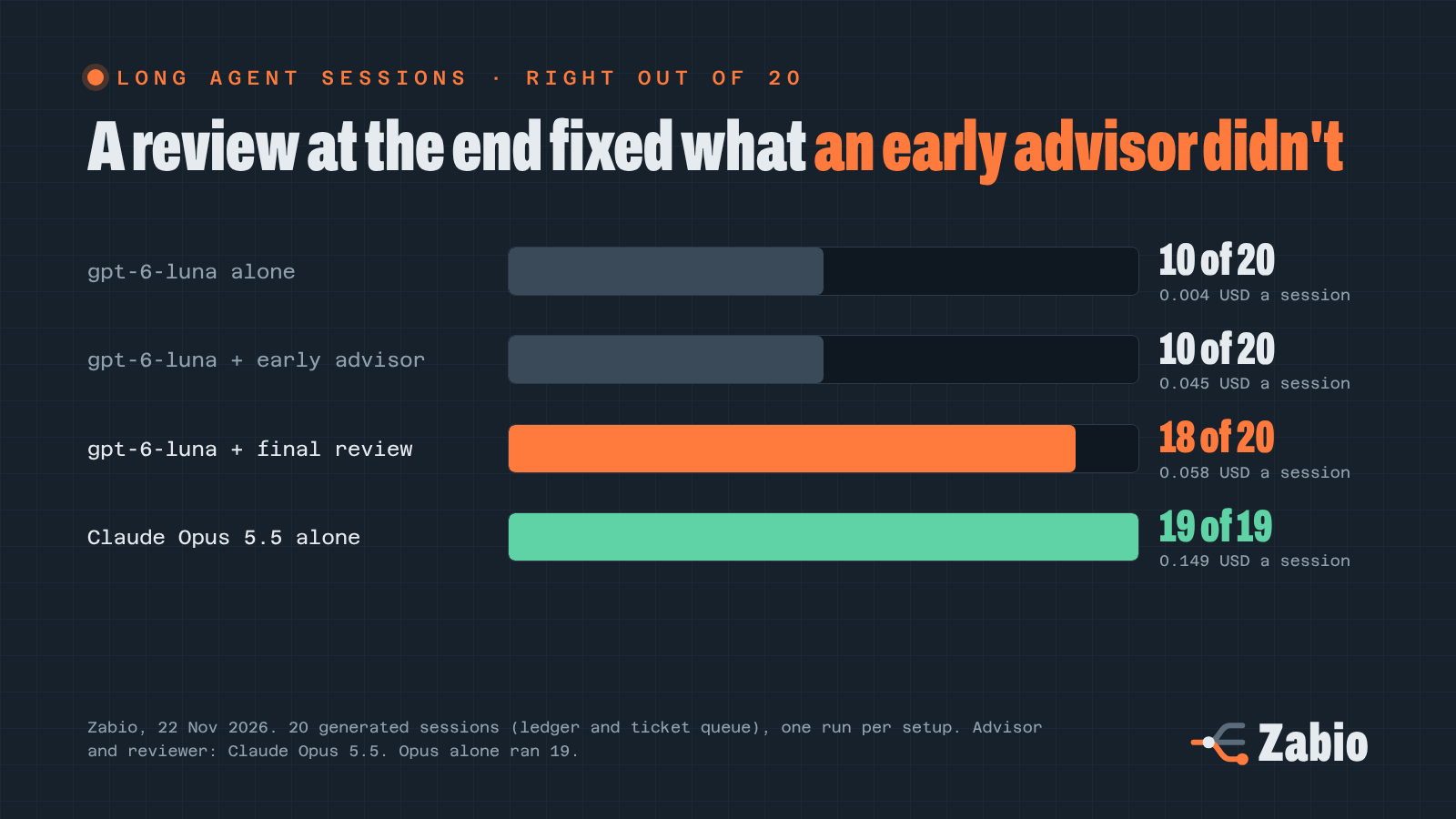
Yes, and here it mattered most. Each of the 20 sessions handed out its data one step at a time: a refund ledger read page by page with corrections on later pages, or a support queue of 18 to 36 tickets routed under a policy. They took 19 to 90 turns. A program checked every result.
| Setup, on 20 long sessions | Right | Mean cost per session (USD) |
|---|---|---|
gpt-6-luna alone |
10 of 20 | 0.004 |
gpt-6-luna with an early advisor (Claude Opus 5.5) |
10 of 20 | 0.045 |
gpt-6-luna with a final review (Claude Opus 5.5) |
18 of 20 | 0.058 |
| Claude Opus 5.5 alone | 19 of 19 | 0.149 |
Inside the same runs, gpt-6-luna was right on 7 of the 19 sessions it had answered when the first review read them, and on 18 at the end: 11 sessions fixed, none broken. The first review told right from wrong without a miss. It agreed with 7 of 7 right answers and disagreed with 12 of 12 wrong ones. On the ticket queue it named 18 of the 23 wrong tickets by their id, and on the ledger it gave the exact total in 5 of 5 disagreements.
Why does a review at the end beat an advisor at the start?
Because the mistakes come late. An advisor is a strong model the cheap one may consult while it works, the pattern of Anthropic’s advisor tool. gpt-6-luna asked it early, at turn 1 at the median, and on the ticket queue mostly only once. Its wrong sessions were one or two tickets wrong out of 18 to 36, handled after its last consultation. The advisor never saw them. Advised, it was right on 10 of 20, the same as alone.
A final review reads the whole transcript once, after the work is done, so it sees every step that went wrong. That is also why its cost grows once per review and not once per turn.
How many reviews does a long task need?
One review caught most of it; a second and third caught the rest. When a revision changes work the model does with your tools, its next answer is a new answer, and it is reviewed again.
| Reviews per session, at most | Right | Mean cost per session (USD) |
|---|---|---|
| 1 | 15 of 20 | about 0.040 |
| 2 | 17 of 20 | about 0.054 |
| 3 | 18 of 20 | 0.058 |
There were 1.5 reviews per session on average. Ten sessions had one, seven had two, two had three, and one, which never answered, had none.
What does the review cost against the strong model?
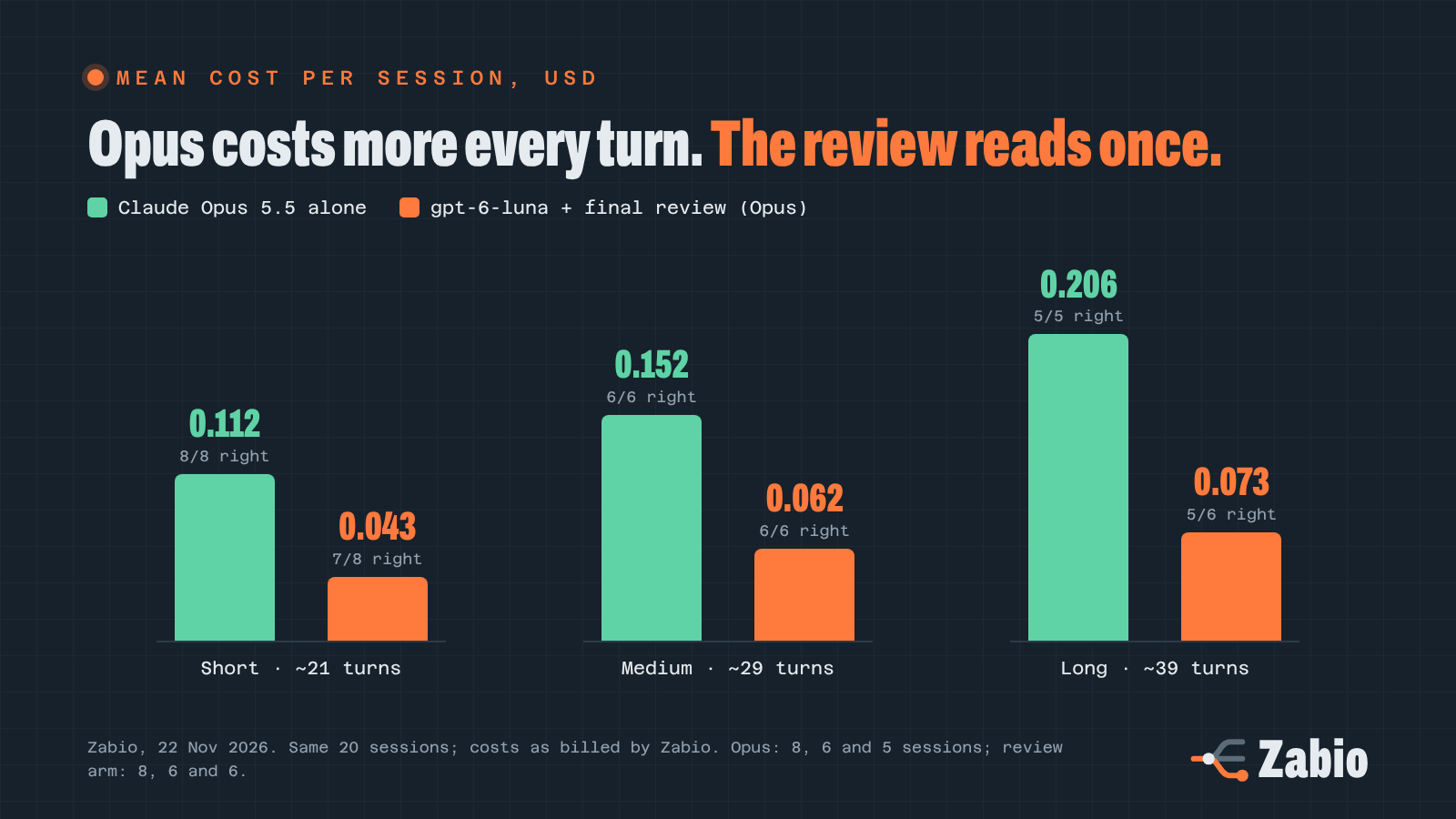
Less, and the gap widens with length. Claude Opus 5.5 alone costs more with every turn, because it reads the growing transcript and writes each step. The review reads the transcript once.
| Session length (Opus turns) | Opus alone: right, mean cost (USD) | gpt-6-luna with the review: right, mean cost (USD) |
|---|---|---|
| Short, about 21 | 8 of 8, 0.112 | 7 of 8, 0.043 |
| Medium, about 29 | 6 of 6, 0.152 | 6 of 6, 0.062 |
| Long, about 39 | 5 of 5, 0.206 | 5 of 6, 0.073 |
An Opus review cost 0.033 USD at the median (0.020 to 0.061), and 90 percent of the reviewed sessions’ cost was the reviews. The reviews here read transcripts of about 2,700 to 11,000 tokens. On real coding sessions of 50,000 to 150,000 tokens, one Opus reading would cost about 0.2 to 0.6 USD by the same rates: still one reading, but no longer cheap.
When is the reviewer wrong?
Often enough that it must advise, not overrule.
- False alarms. On short tasks it disagreed with 3 of 6 right answers. On long sessions, 4 of the 11 reviews after a revision disagreed with a right answer, each time over a policy line that could be read two ways. The model kept its answer every time.
- Misses. On one ticket queue the reviewer missed the same wrong ticket twice.
- Nothing to review. One session reached 90 turns without an answer. No review can help a model that never finishes.
- Actions that cannot be undone. On the ticket queue the fixes redid earlier actions. Where an action cannot be redone, like a sent mail or a payment, a review catches the error but cannot fix it.
So the model that answered gets the review and decides. In our runs it kept its right answers every time but once: a revision that re-routed two right tickets, which the next review caught.
How to add a second-model review
What any team can do:
- Review after the answer, not before the work. Errors in long tasks come late.
- Give the reviewer the whole conversation, tool results included. Without the data, a reviewer is mostly guessing.
- Use a reviewer from another vendor than the model that answered, so they are less likely to share a blind spot.
- Let the reviewer advise and the model decide. Send the review back as a user turn and allow one more answer.
- Leave the reviewer room to write. A strong model can spend its whole output budget reasoning over a long transcript and return nothing.
- Measure on your own tasks, with answers a program can check, before you trust the rate.
How Zabio does it: on chat completions, the header x-zabio-final-review: revise or a zabio:review entry in tools has a second model read the whole conversation and the answer. In revise a disagreement goes back to the model you called, which answers once more; in report the answer goes out with the review beside it. Name the reviewer we measured:
curl https://api.zabio.ai/v1/chat/completions \ -H "Authorization: Bearer insert your zabio.ai key here" \ -H "Content-Type: application/json" \ -d '{"model": "gpt-6-luna", "messages": [{"role": "user", "content": "..."}], "tools": [{"type": "zabio:review", "parameters": {"mode": "revise", "model": "claude-opus-5-5"}}]}'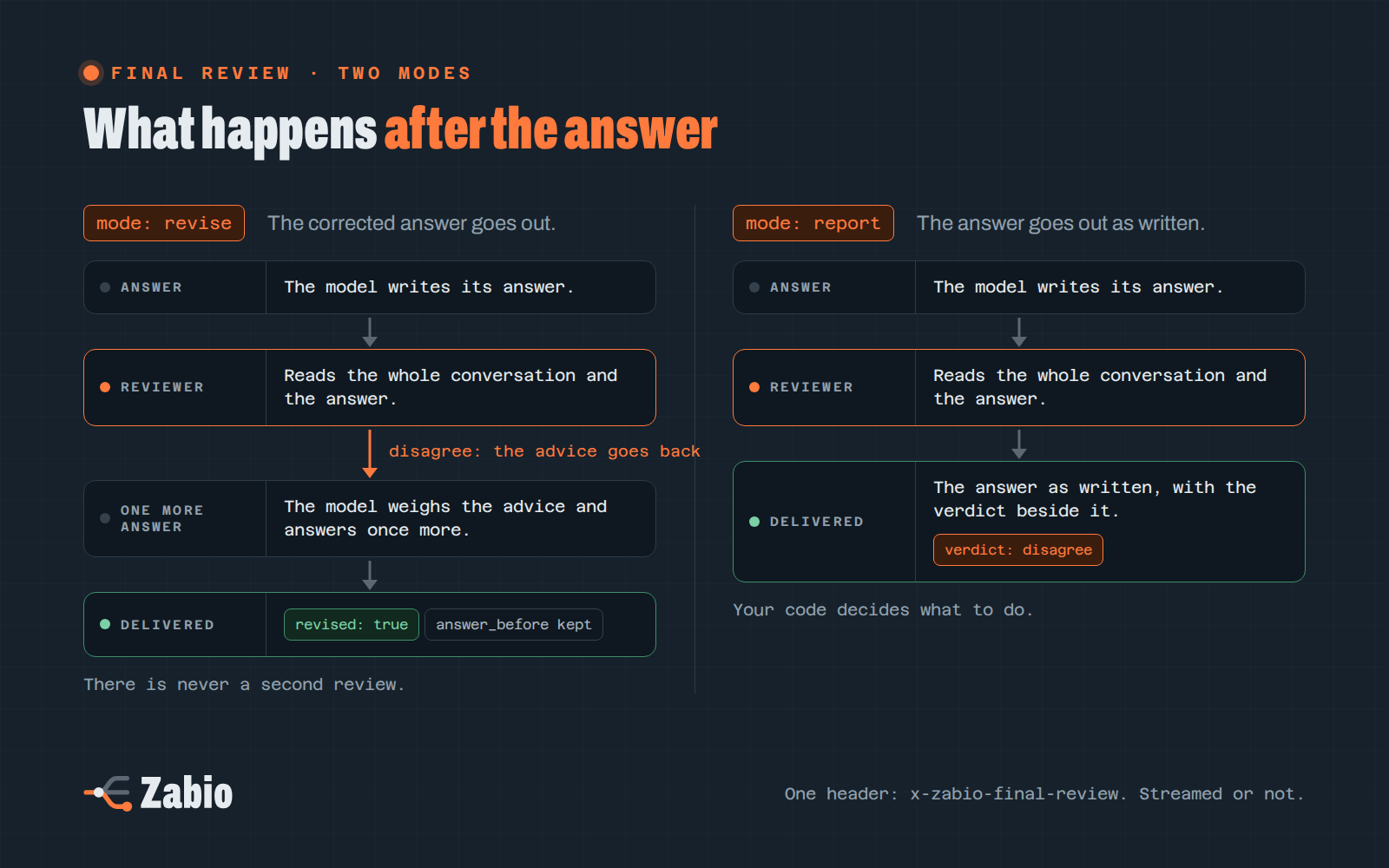
The verdict, the advice and the first answer come back in zabio.review, and the review is billed on a line of its own at the reviewer’s price. A task gets up to 3 reviews. The full reference is in the docs: Final review. See also Sub-agents and How to protect AI agents.
How we measured
- Short tasks: 12 agent tasks generated from a seed by a program that also computes the answer (refunds, incident triage, approvals, session logs; 3 of each).
claude-haiku-5-5answered andgpt-6.1-solreviewed, and in a second pairinggpt-6-lunaanswered andclaude-opus-5-5reviewed. 20 November 2026. - Long sessions: 20 sessions of two generated families (a paged refund ledger with later corrections, a ticket queue of 18 to 36 tickets), 19 to 90 turns, data handed out one step at a time so no model could read ahead.
gpt-6-lunaanswered, withclaude-opus-5-5named as the reviewer inrevisemode, up to 3 reviews a session. The other setups ran on the same sessions: each cheap model alone, with an optional or forced advisor, and Opus alone. 22 November 2026. - Scoring: a program checked every final answer against the computed key: money to the cent, every ticket’s action. No model graded another.
- The review: the reviewer read the whole conversation and the answer and began with a verdict line. Each review was graded on the state it read.
- Cost: what Zabio billed for every call, from its API. The studies cost about 15 USD in all.
- What we did not measure: reviewers other than Opus on long sessions, the reviewer Zabio picks by default (
auto/best, changed on 22 November to pick only its two highest tiers), real customer or coding sessions, transcripts above about 11,000 tokens, and run-to-run noise: each setup ran once per session. Twelve tasks and twenty sessions show the direction, not a precise rate. - Data: every run as CSV (one row per run, no prompts, answers or review text) and as JSON, also on Hugging Face under CC BY 4.0.
Updated 2026-11-25: retitled as the question it answers; added the long-session results, the comparison with an early advisor, the cost by length, when the reviewer is wrong, the sources and the dataset.
Frequently asked questions
Can one LLM check another LLM's answer?
Yes, when the reviewer reads the whole conversation and the data. In Zabio's tests of November 2026, a reviewer flagged 6 of 6 wrong answers on short tasks and 12 of 12 on long agent sessions at its first reading.
Does a second-model review make a cheap model as good as an expensive one?
Close, at a fraction of the cost. On 20 long agent sessions, gpt-6-luna with a Claude Opus 5.5 review was right on 18 of 20, against 19 of 19 for Opus alone, at 38 percent of Opus's cost.
Is a reviewer at the end better than an advisor during the task?
On our long sessions, yes. An advisor consulted at the start lifted nothing (10 of 20, as alone), because the mistakes came later. A review of the final answer caught them and took the model to 18 of 20.
Can the reviewing model be wrong?
Yes. On 12 short tasks it disagreed with 3 of 6 right answers, and on long sessions 4 of 11 later reviews disagreed with a right answer. The model that answered kept its right answers each time, which is why the review should advise, not overrule.
How much does a second-model review cost?
In our tests an Opus review cost 0.033 USD at the median and a whole long session with reviews 0.058 USD, against 0.149 USD for Opus alone. The review reads the transcript once, so its cost grows with the transcript once per review, not once per turn.
Sources and references
- Huang et al., Large Language Models Cannot Self-Correct Reasoning Yet (arXiv 2310.01798) arxiv.org
- Madaan et al., Self-Refine: Iterative Refinement with Self-Feedback (arXiv 2303.17651) arxiv.org
- Zheng et al., Judging LLM-as-a-Judge with MT-Bench and Chatbot Arena (arXiv 2306.05685) arxiv.org
- McAleese et al., LLM Critics Help Catch LLM Bugs (arXiv 2407.00215) arxiv.org
- Du et al., Improving Factuality and Reasoning in Language Models through Multiagent Debate (arXiv 2305.14325) arxiv.org
- Anthropic, Advisor tool (Claude Platform Docs) platform.claude.com
- Hugging Face huggingface.co
Build your prototype free
Change two lines in your code, send model auto, and see what every call cost and what you saved.