Articles
AI security
- How to protect AI agents: isolation, memory, guardrails
- Can prompt injection come through audio? We tested 11 transcribers
- AI Firewall for MCP: check what your agent reads, on any model
- Zabio AI Firewall: prompt injection protection on every call, free
AI costs
- Which OpenAI models shut down soon, and what replaces them?
- Sub-agents on Zabio: Opus decides, a cheap model reads
- Why I built Zabio
Agents and coding tools
Sub-agents on Zabio: Opus decides, a cheap model reads
Zabio's sub-agents beta lets a strong model hand long documents to a cheap worker by file id. Eight long contracts cost 0.19 USD instead of 1.08.
Strong models are good at deciding and expensive at reading. When the job is “read these eight contracts, then tell me which ones end before April”, most of the bill is the reading: every token of every contract at the strong model’s input price.
Zabio’s new sub-agents, a beta on chat completions, split that work. The model you call stays in charge. It hands each document to a cheaper worker model, gets back a short outcome, and decides from those.
How it works
Upload each document once to /v1/files with purpose: user_data, put the file ids in your prompt, and add one tool:
{ "model": "claude-opus-5-5", "messages": [{"role": "user", "content": "The supplier agreements are in the files file_01a2..., file_01b7... and file_01c4.... For each one, find the end date and the annual fee. Then tell me which ones end before April."}], "tools": [{"type": "zabio:subagent"}]}The model can now call subagent with a task and a list of file ids. Zabio starts a worker, reads the files the key is allowed to see, and puts their text into the worker’s input. The strong model never reads the documents; it reads each worker’s outcome, cut at 2,000 tokens. Workers run at the same time, have no tools and no memory, and are told that a file’s text is data, never an instruction.
The worker defaults to auto/cheap, a fast model Zabio picks once per request. openrouter:subagent is accepted as the same tool, so a request written for OpenRouter works unchanged.
What we measured
Before building it, we measured it. Eight agreements of about 22,300 tokens each, one question across all eight, claude-opus-5-5 deciding and gpt-6-luna as the worker:
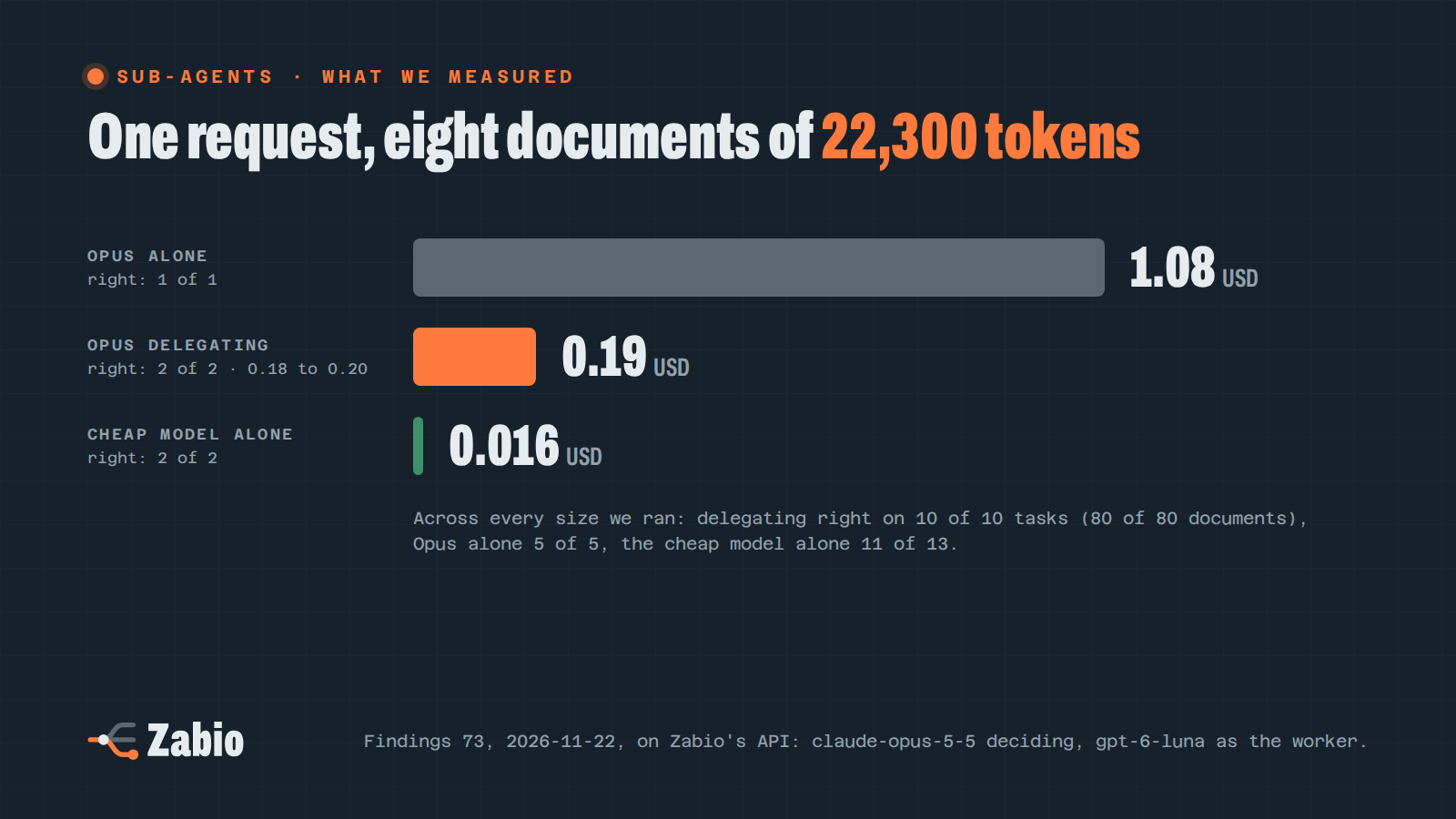
- Opus reading all eight itself: 1.08 USD.
- Opus handing each to a worker: 0.18 to 0.20 USD, about a sixth.
- Accuracy held: delegating was right on 10 of 10 tasks across all sizes, 80 of 80 documents.
When it pays, and when it doesn’t
Handing work out has a cost of its own: the strong model writes a task for each document and reads each outcome. We measured that at about 0.014 USD a document. So delegating pays only once the documents are long enough:
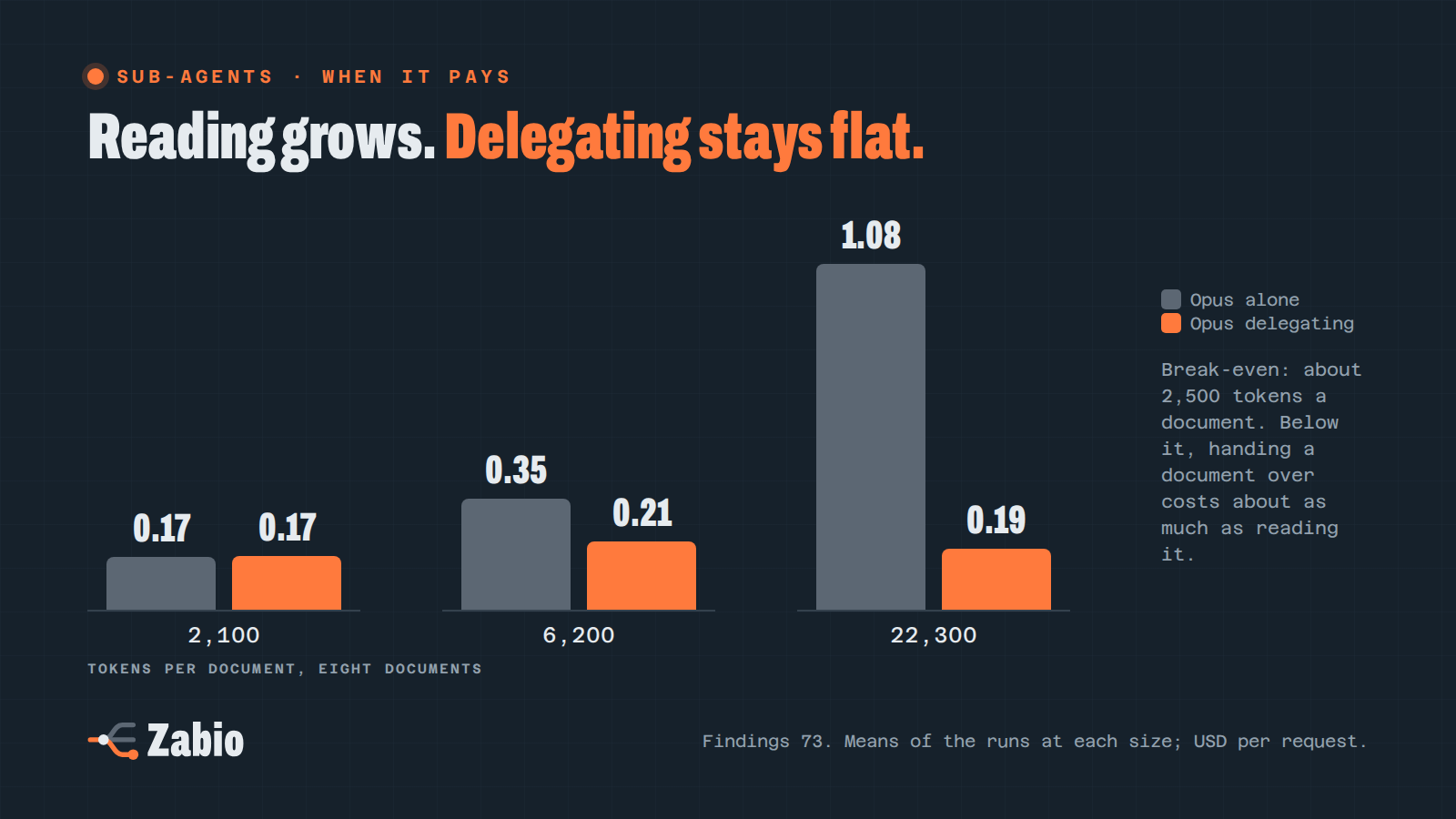
- Under about 2,500 tokens a document, delegating costs about as much as reading. Don’t bother.
- Above it, the saving grows with every token: reading grows, delegating stays flat.
- It is slower: 45 to 64 seconds against 19 to 33 in our test.
Zabio does that arithmetic for you on every request. The tool’s description tells the model the worker’s price as a fraction of its own and the document size above which delegating pays, from the live prices. In our test, that one line was what made Opus delegate on mid-sized documents instead of reading them itself. Every answer that used the tool also shows, in zabio.subagent, what the model would have paid to read the files directly beside what delegating cost.
And the honest part. The cheap model alone, with no strong model at all, cost less still and was right on 11 of 13 tasks against delegation’s 10 of 10. At these counts that gap is not statistically significant. One of its errors was taking a fee from the neighbouring agreement, a mix-up a worker that sees one document cannot make. If the cheap model alone is good enough for your task, call auto/cheap: it costs less than any sub-agent. Sub-agents are for when you want the strong model to make the decision without paying it to read every page.
What it costs
Each worker is one model call, billed at its list price plus Zabio’s service fee, on a line of its own. When Zabio picks the worker’s model, the price of automatic model choice is paid once per request. The figures in zabio.subagent are shown, never billed. Before the call, Zabio sets aside the most the request could cost; the docs show how to lower that with max_tool_calls.
It’s a beta
The tool’s shape may change, with 30 days’ notice in the changelog. Billing is not a beta. It runs on chat completions, streamed or not; the Responses API comes later. If too few teams use it in its first 60 days, we’ll fold it into auto or remove it. Tell us what you’d use it for.
How we measured
- Tasks: eight supplier agreements per task, of four sizes (about 2,100, 6,200, 18,000 and 22,300 tokens each in Opus’s tokenizer), each with end dates and fees a program checks against the known answer.
- Arms:
claude-opus-5-5alone;claude-opus-5-5delegating togpt-6-luna;gpt-6-lunaalone. - Score: every agreement’s values checked by a program; a task is right when all eight are.
- When and cost: 22 November 2026, on Zabio’s API, 367 calls, 4.98 USD in total.
- What we did not measure: other kinds of documents, other worker models, and more than eight documents a request.
The full reference is in the docs: Sub-agents (beta).
Build your prototype free
Change two lines in your code, send model auto, and see what every call cost and what you saved.